

The Cost of Waiting Too Long
You know the feeling. The warehouse is stacked too high. The team is tripping over each other. You're turning away orders you should be fulfilling, or running a second shift just to keep pace with demand that isn't slowing down. You've told yourself you'll deal with it when things calm down. When Q4 is behind you. When the loan comes through. When you have a minute to sit down and figure it all out.
Here's what nobody tells you: waiting has a price tag. And it compounds every month you don't act on it.
This post, and the FAQ below, is for business owners who are somewhere between "we probably need more space" and "okay, how do we actually make this happen." It's for the person who doesn't have a real estate team, has never hired a construction company, and isn't sure where to even start.
You're in the right place. Let's walk through what's actually happening when you wait, what the process looks like when you start early, and what the most common questions are from business owners just like you.
The Hidden Ledger
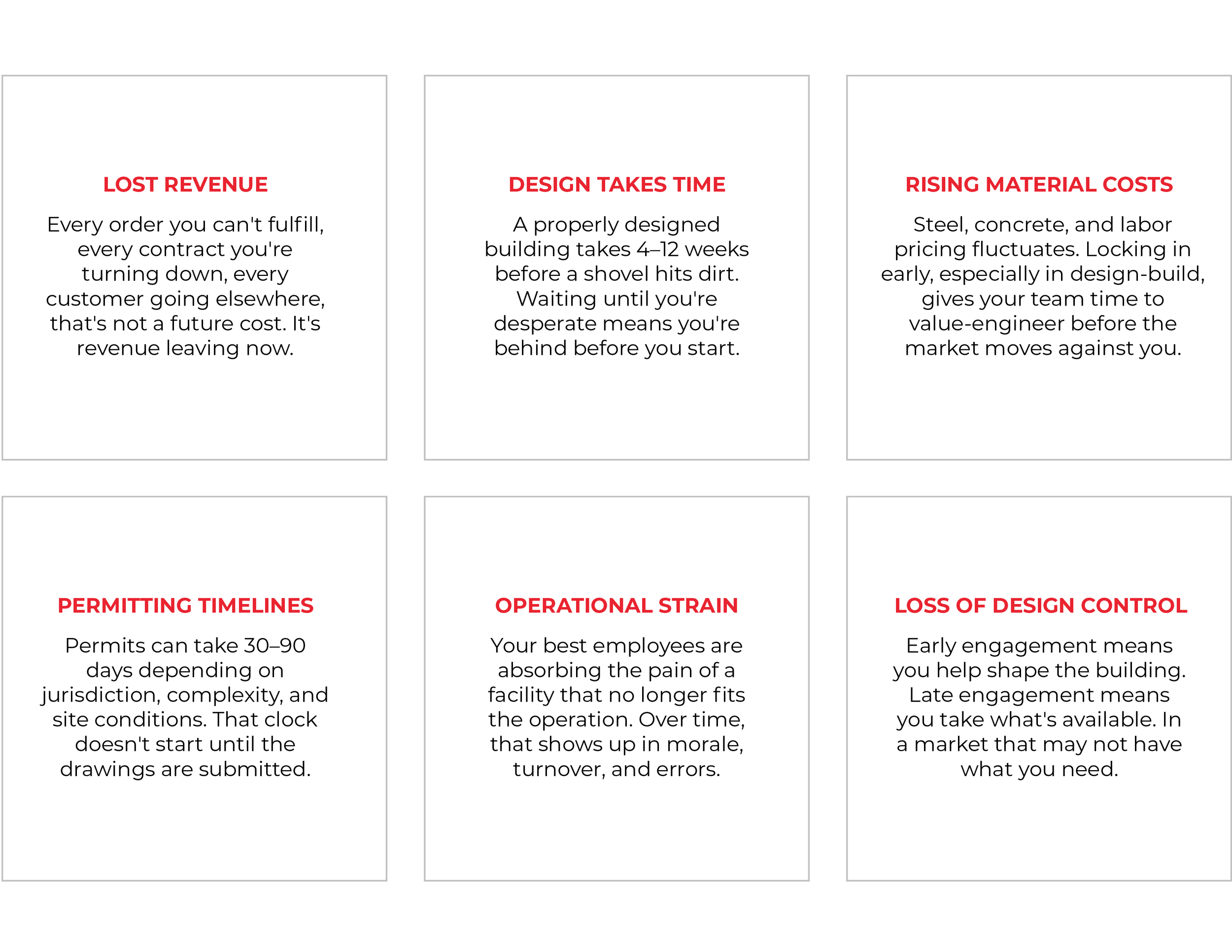
What Waiting Actually Costs You
The delay feels free. It isn't. Here's what's accumulating on the other side of the ledger while the decision sits.
What Early Looks Like
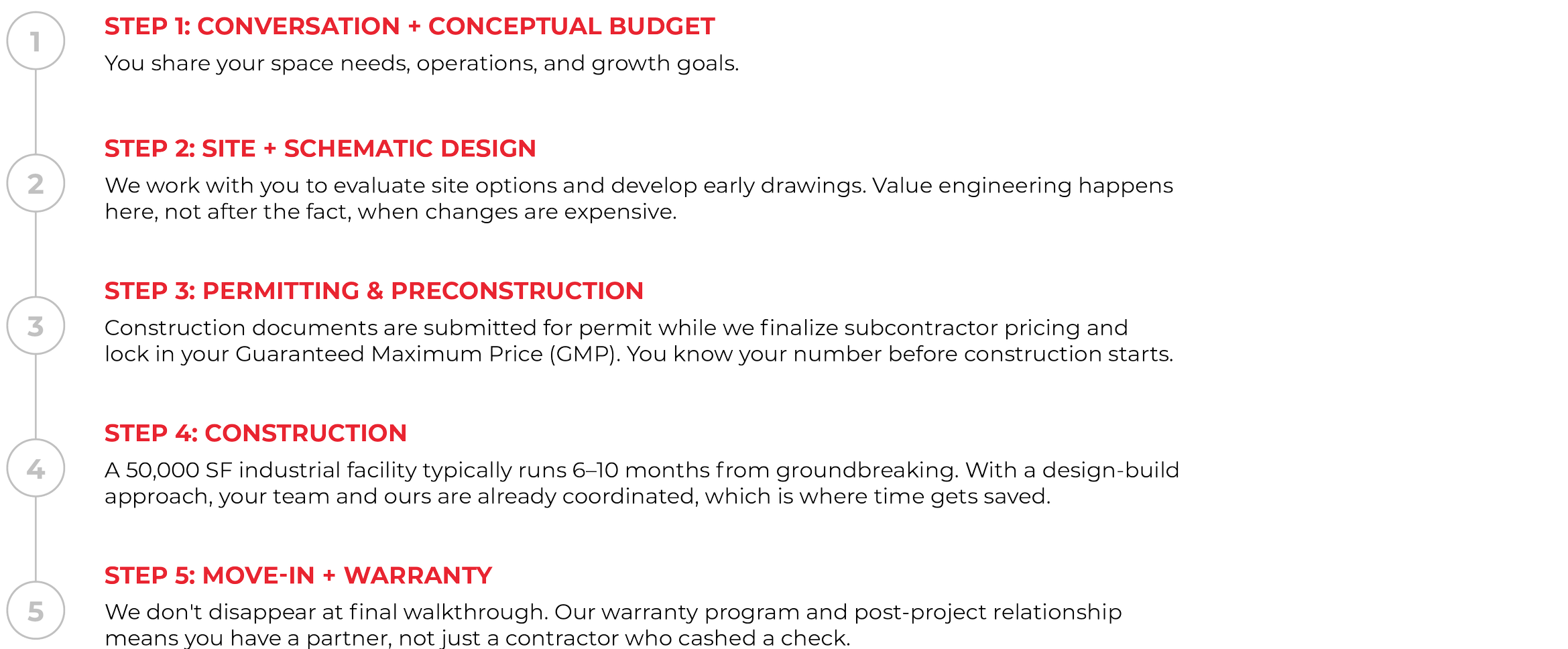
The Right Timeline for a Design-Build Project
Most business owners underestimate how long a building project takes from first conversation to move-in day. Check this simplified view of what early engagement makes possible and how it can help your business.
Frequently Asked Questions
Questions Business Owners Ask Us
I don't even have drawings yet. Is it too early to call?
No, and this is actually the best time to call. Most business owners assume they need drawings, a site, a contractor, a budget, and a complete plan before reaching out. The reality is the opposite. The earlier you involve a design-build partner, the more influence you have over the outcome. We help you think through site selection, space requirements, cost expectations, and sequencing before you've made any commitments. Calling before you have drawings is not premature; it's strategic.
How long does a project actually take from start to finish?
It depends on the scope, but most business owners significantly underestimate the timeline. A ground-up industrial or commercial facility, even a modest one, typically takes 12 to 24 months from first conversation to occupancy, depending on size, site complexity, and permitting jurisdiction. The design-build delivery method compresses that timeline meaningfully compared to traditional design-bid-build, because design and construction overlap rather than happen sequentially. But there is no shortcut to planning, permitting, and building something well. If you think you need a building in 6 months and you're calling today, we'll tell you the truth about what's possible and help you solve for it.
What's a conceptual budget, and why does it matter?
A conceptual budget is an early, detailed cost analysis of what a building like yours typically costs to build. It's based on historical data from comparable projects, your stated needs, and reasonable assumptions about construction quality and scope. It is not a wild guess, and it is not a binding number. What it does is give you a real financial reference point so you can make decisions with confidence, whether that's talking to a lender, evaluating a site, or deciding whether to move forward at all.
What is design-build, and why does it matter to me as a business owner?
In traditional construction, you hire an architect, they design your building, and then you go find a contractor to build it. The architect and contractor work under separate contracts and have no legal obligation to agree with each other. When something goes wrong, you're in the middle of it. Design-build puts the architect and the contractor on one team, under one contract, accountable to you for the whole outcome. That means faster timelines, fewer surprises, and a single point of accountability. For business owners who don't have a dedicated real estate team, design-build is the model that reduces complexity, not adds to it.
I'm worried about disruption to my current operation. How do you handle that?
This is the question we hear most often, and it's the right one to ask. Construction near or adjacent to an active operation is a genuine risk, and the quality of your contractor's planning is what determines whether it becomes a problem. We spend a significant portion of preconstruction mapping your operational constraints: delivery schedules, employee access, noise-sensitive hours, and critical production cycles. We build phasing plans that protect your business, not just your building. We've worked with manufacturers, distributors, and food processing facilities that couldn't afford a single day of downtime, and they stayed running throughout construction.
The goal is simple: your customers shouldn't notice you're building anything.
What does "Guaranteed Maximum Price" mean, and is my price actually guaranteed?
A Guaranteed Maximum Price (GMP) contract means that once we've finalized drawings and specifications, we lock in a ceiling price, and we can't exceed it without a change in your project scope. If we find savings during construction through smarter buying or better sequencing, those savings come back to you or are shared transparently. If we encounter cost increases within the defined scope, that's our problem to solve, not yours. This is fundamentally different from a low-bid, lump-sum contract where the base price looks low but change orders pile up throughout the project. With a GMP, you know your number before a shovel hits the ground.
I've gotten burned by contractors before. Why would this be different?
That's a fair and honest question, and the fact that you're asking it tells us something important about what you need. Most bad contractor experiences come from three places: a lack of clarity on scope, a communication breakdown mid-project, or a contractor who won in a low-bid process and then recovered their margin through change orders. The design-build model eliminates the first problem by design. We address the second with structured communication cadences and a dedicated point of contact throughout your project. And we eliminated the third by walking away from low-bid pursuits entirely. We don't compete on who can get you the lowest number. We compete on who can give you the most predictable outcome.
What's the single most costly mistake business owners make when planning a facility project?
Starting too late and then trying to compress a timeline that can't be compressed. The pressure to accelerate because of a delayed start forces shortcuts: less value engineering, fewer subcontractor bids, rushed decisions on specifications that affect the building for 30 years. Those shortcuts cost real money; often more than the cost of the time you thought you were saving. The business owners who come out ahead are the ones who engage early, move through preconstruction deliberately, and let the process do what it's designed to do. Speed in construction doesn't come from rushing. It comes from planning so well that there are no surprises.
How do I know if EXXCEL is the right fit for my project?
We're going to tell you directly if we're not. We don't pursue every project, and we'll tell you in the first conversation if your project isn't a fit for the design-build process, if the budget expectations aren't aligned, or if the timeline isn't realistic. What we won't do is take your budget exercise and disappear. Every engagement starts with a qualification conversation, a clear picture of mutual expectations, and an honest assessment of what's possible.
Contact our team today and get a jumpstart on your next project.